EN 09/02/2026 | TECH INSIGHT
More Capacity, More Weight: The Dilemma of Giant Air Carts
High-capacity seeding systems consume seed and fertilizer at an ever-increasing rate. Air carts have grown to keep pace with that productivity and reduce refill stops. But autonomy comes at a cost: more tonnes have to travel across the field. The challenge is no longer simply to carry more, but to find the right balance between capacity, weight, soil conditions and logistics.
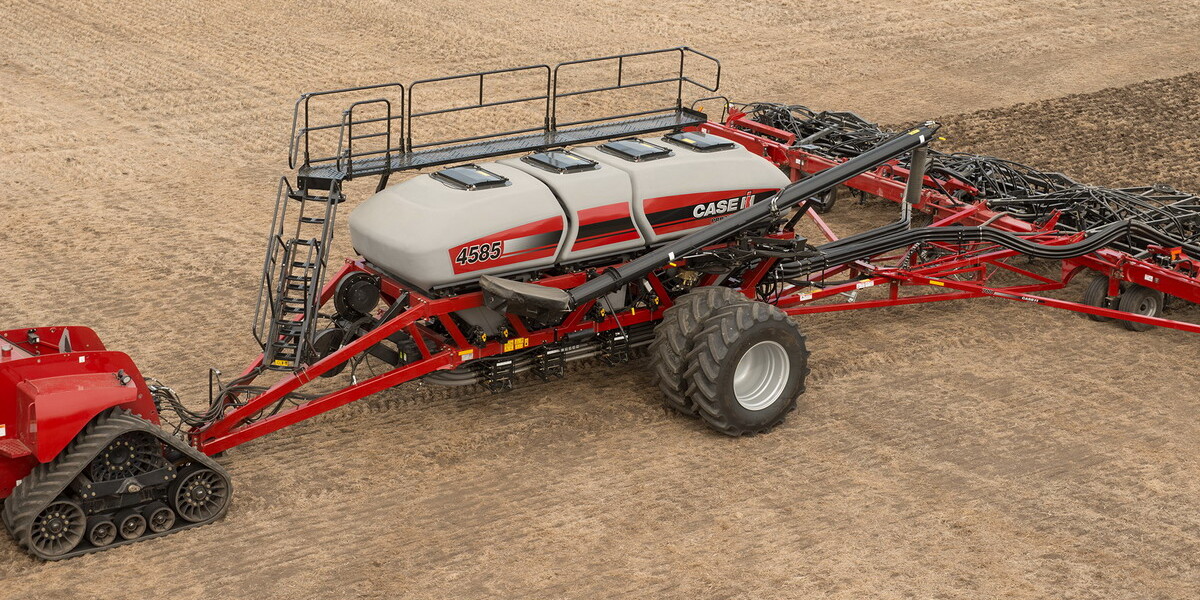
Seeders can get wider, operate faster and cover more hectares per hour. But there is one variable that does not disappear as productivity increases: covering more ground also means carrying and applying more seed and fertilizer.
And those inputs take up space — and, more importantly, they have weight.
That simple equation explains much of the growth of air carts, the units that store, meter and pneumatically convey seed and fertilizer to the seeding implement.

In large-scale seeding systems, increasing air cart capacity extends the time between refills and helps make better use of machines capable of covering vast areas in a working day.
But that solution creates a dilemma of its own.
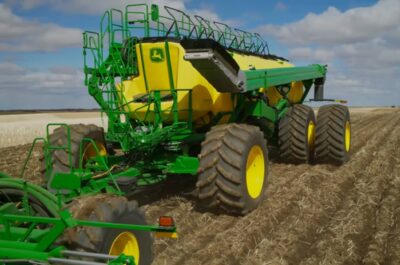
The largest air carts now offer capacities measured in the tens of thousands of litres, with some models exceeding 50,000 litres. When those tanks are full, the weight of the machine itself is joined by a payload that can amount to tens of tonnes.
So the question is no longer how much product can fit into an air cart.
It is how far it makes sense to keep increasing its capacity.
When stopping becomes increasingly expensive
 At the heart of the issue is the difference between theoretical and effective field capacity.
A seeder may be exceptionally wide and capable of operating at high speeds, but its productivity over the course of a day also depends on how much of that time it actually spends seeding.
Every stop to refill seed or fertilizer interrupts the operation.
And the issue becomes increasingly significant as machine capacity rises. A seeder covering more hectares per hour also consumes more inputs per hour. Unless onboard storage grows accordingly, some of the capacity gained through greater width or speed can be lost to more frequent refill stops.
Higher productivity therefore creates a new bottleneck of its own.
One way to address it is simply to carry more product. Separating those large volumes from the seeding toolbar through an air cart makes it possible to reach capacities that would be difficult to accommodate directly on the seeder itself.
The logic appears straightforward:
More capacity → more autonomy → fewer refills → more time seeding.
But there is a second half to the equation:
More capacity → more product carried → more mass → greater demands on the entire machine system.
That is where the dilemma begins.
Autonomy is also measured in tonnes
 Air cart capacity is usually expressed as a volume. From the perspective of both the machine and the soil, however, litres tell only part of the story.
What matters is what those litres contain.
Seed and fertilizer can have very different bulk densities. A multi-compartment air cart may also carry several products simultaneously in different proportions.
The same nominal volume can therefore translate into substantially different payloads.
And everything that allows the seeding system to operate longer without stopping still has to be carried across the field.
The challenge is not simply having enough tractor power to pull it. The running gear has to support the load, maintain mobility under varying conditions and transfer that load to the ground in a way that is compatible with the soil beneath it.
In other words, increasing autonomy does not eliminate a problem: it trades refill time for transported weight.
Weight and soil compaction are not the same thing
 It is easy to assume that a larger air cart will necessarily cause more soil compaction. But the interaction between a heavy machine and the soil is considerably more complex.
It is not only total weight that matters, but how that weight is distributed.
The number of wheels, wheel or axle loads, tyre dimensions, inflation pressure, contact area and the use of track systems all affect how loads are transmitted to the soil.
Soil conditions matter as well. Texture, structure, moisture content and bearing capacity can cause the same machine to interact very differently with the ground under different conditions.
This is why the growth of air carts has placed increasing emphasis on running gear. High-volume tyres, multiple-wheel arrangements and track systems are all used to increase the contact area and manage increasingly large loads.
But distributing a load more effectively does not make that load disappear.
Reducing contact pressure is particularly relevant near the surface, while the risk of deeper soil compaction is also influenced by the magnitude of the loads the soil has to support.
The distinction matters: flotation can help manage a heavy air cart, but it does not make weight irrelevant.
The soil sets its own limits
There is another constraint that does not appear on an air cart specification sheet.
A machine may be perfectly capable of carrying a particular load and still encounter soil conditions in which doing so is undesirable.
This becomes especially important during seeding, when the opportunity to enter a field can depend on narrow weather windows.
Greater autonomy is attractive because it allows those windows to be used with fewer interruptions. Paradoxically, however, the mass required to achieve that autonomy can become more problematic precisely when the soil has less capacity to support heavy traffic.
For that reason, capacity and field access do not always improve together.
A larger tank allows the seeding system to keep working longer once it is in the field. It does not necessarily expand the range of conditions in which operating that system is advisable.
Where the air cart runs matters too
The dilemma takes on another dimension depending on where the cart is positioned within the seeding system.
In a tow-between configuration, the basic sequence is tractor, air cart and seeder. The cart therefore travels over the ground before the seeding units.
In a tow-behind configuration, the seeder works first and the air cart follows behind it.
The choice involves much more than deciding whether the cart should run ahead of or behind the seeder. Its position affects how draft loads are transmitted, manoeuvrability, the behaviour of the overall combination and the interaction between wheel or track traffic and the work performed by the seeding units.
It is a good example of how increasing storage capacity eventually influences much more than the tanks themselves.
As air carts become larger, they cease to be merely the place where inputs are stored and increasingly influence the architecture and behaviour of the entire seeding system.
But how much autonomy is actually needed?
This may be the question that puts the entire capacity race into perspective.
A larger air cart offers an obvious benefit when refilling is one of the main factors limiting the number of hectares that can be seeded in a day.
But not every operation has the same bottleneck.
The autonomy required depends on seeder width and operating speed, application rates, the products being carried and the capacity of the supporting logistics.
A high fertilizer rate, for example, can empty a tank much faster than an operation dominated by seed applied at a relatively low rate. Capacity expressed in litres means little unless it is translated into how many hectares that load will cover.
And there is still another question to answer: what happens when the air cart finally has to be refilled?
An air cart cannot refill itself
Increasing capacity reduces refill frequency, but it does not eliminate the need to move seed and fertilizer to the seeding operation.
Behind the air cart is another chain: trucks, trailers, seed tenders, transfer systems, labour and transport distances that must keep inputs available at the right place and at the right time.
An air cart capable of operating for many hours between stops can lose part of that advantage if, when it finally runs empty, the infrastructure required to replenish such a large volume cannot do so quickly.
In that case, increasing tank capacity does not necessarily remove the bottleneck. It may simply change its shape.
There will be fewer stops, but each one will involve larger quantities of product.
Air cart capacity and the capacity of the supply system therefore need to evolve together.
The biggest machine does not always make the most productive system
This issue extends well beyond air carts.
As agricultural machinery becomes more capable, evaluating each machine in isolation becomes increasingly misleading.
An exceptionally productive seeder needs enough input capacity to keep pace with it. A large air cart requires an appropriate tractor and running gear, but also a logistics system capable of keeping it supplied. And the entire combination has to operate on soil whose physical limits cannot simply be overcome by making machines larger.
Actual productivity emerges from the interaction between all of those components.
That is why the appropriate size of an air cart cannot be determined simply by asking what the largest available capacity is.
The better question is:
What capacity allows the entire system to operate with the fewest interruptions without imposing a disproportionate cost in weight, trafficability, draft requirements or logistics?
The answer will differ according to crop, application rates, field size, transport distances, soil conditions and the way each operation is organised.
The next litre has to justify its weight
Giant air carts are not simply the result of a race to build ever-larger tanks.
They are the logical consequence of seeding systems capable of consuming enormous quantities of inputs and farming operations seeking to make the most of limited working windows with as few interruptions as possible.
In that context, carrying more product offers a tangible advantage.
But every increase in autonomy brings with it an unavoidable physical reality: that product has mass, and that mass has to travel across the field.
Engineering can distribute loads more effectively, increase contact area, use high-volume tyres or tracks and design running gear capable of handling extraordinary weights. Logistics can shorten refill times. Electronics can manage with remarkable precision what leaves each tank.
None of those solutions eliminates the underlying equation.
Perhaps, then, the evolution of air carts should not be judged only by how many litres their tanks can hold, but by something much more complex: how much useful autonomy they can provide without shifting the bottleneck from refilling to weight, soil conditions or the logistics system itself.
Because beyond a certain point, carrying more is no longer an answer in itself.
It becomes a decision that the entire seeding system has to justify.
TECH INSIGHT
- Cutting Faster Isn’t Enough: When Weather Limits Hay Production
- Why Does a Tractor Need Ballast If It Already Has Enough Power?
- The Combine Doesn’t Work Alone: When Logistics Defines Real Harvest Capacity
- Why Can Power Boost Kick In on the Road but Not When Pulling a Heavy Implement?
- The Invisible Transmission: Why Operators Are Making Fewer Gear-Change Decisions

⊕ Tractors
⊕ Combines
⊕ Sprayers
⊕ Forage Harvesters
⊕ Grain Carts
⊕ Mixer Wagons
⊕ Mowers
⊕ Air Carts
⊕ Drapers

MAQUINAC INTERNATIONAL
International coverage of the global agricultural machinery industry.




© Maquinac.
Maquinac is the leading Spanish-language media platform dedicated to the agricultural machinery industry, with more than 20,000 articles covering manufacturers, products, markets, and industry trends.
The No. 1 Agricultural Machinery Portal in Spanish