
EN 09/02/2026 | TECH ANSWERS
What is Strip-Till?
Strip-Till is a localized tillage system that works only narrow strips where the crop will be planted, while leaving the soil between the rows untilled and covered with crop residue.
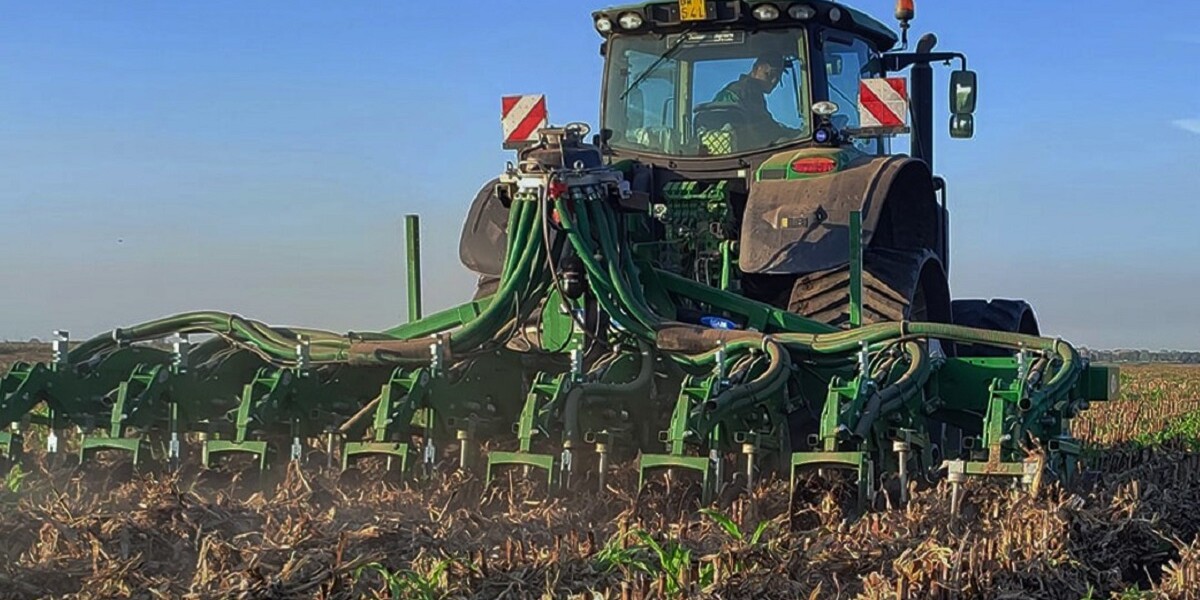
Between full-width tillage and planting without prior soil disturbance, there is a broad range of intermediate systems.
One of them is Strip-Till, a strategy that concentrates soil preparation precisely where the crop will grow while leaving most of the area between future rows largely undisturbed.
The objective is to combine some agronomic benefits of tillage — such as preparing the seedbed, promoting soil warming or incorporating fertilizer — with some of the advantages of maintaining a high proportion of the field untilled.
What is Strip-Till?
Strip-Till is a strip tillage system in which only a relatively narrow band of soil corresponding to the future crop row is tilled.
The term combines strip, referring to the narrow band of soil being worked, and till, meaning to cultivate or work the soil.
Between these strips, the soil remains untilled and retains much of the residue from the previous crop.
For this reason, Strip-Till is generally considered a form of conservation or reduced tillage, occupying an intermediate position between full-width tillage and No-Till.
What is Strip-Till used for?
The objective is to specifically condition the area where seeds will be placed and early root development will occur without tilling the entire field.
Depending on conditions and system configuration, the tilled strip can help to:
Prepare the seedbed
Alleviate localized compaction
Promote soil warming
Improve early crop establishment
Incorporate fertilizer
Concentrate nutrients near the crop row
Maintain residue between rows
Reduce the total area subjected to tillage
The fundamental principle is to work the soil where necessary while leaving the rest largely undisturbed.
How does Strip-Till work?
A Strip-Till implement travels across the field working only the future planting rows.
Depending on its configuration, different components can cut through residue, partially clear the row, loosen the soil, work at a selected depth, apply fertilizer and reshape the soil surface.
The result is a conditioned strip ready for crop establishment, separated from the next strip by an area that remains largely untilled and covered with crop residue.
Strip width and working depth are not universal. They depend on factors such as:
Crop
Row spacing
Soil type
Soil moisture
Residue levels
Agronomic objective
Implement design
Rather than being defined by specific dimensions, Strip-Till is characterized by the concept of localized tillage along future crop rows.
When is Strip-Till performed?
There are two main strategies.
In a separate pass. The strips are prepared first, and the crop is planted over them later.
At the same time as planting. Strip preparation and crop establishment are performed during a single pass with a specially configured machine combination.
The choice depends on soil conditions, climate, crop, available machinery and agronomic strategy.
What are the advantages of performing Strip-Till before Planting?
Separating the two operations allows the strips to be prepared in advance and gives them time to change before planting.
Under certain conditions, this can allow the soil to settle and the strip to warm or lose excess moisture before seed placement.
It also separates the power and field-capacity requirements of tillage and planting.
However, it introduces a fundamental challenge: the planter must return precisely to the strips that were previously prepared.
Why is Positioning so important?
Because a properly prepared strip loses much of its value if the seed is subsequently placed outside it.
When Strip-Till and planting are performed in separate passes, repeatable field positioning becomes particularly important.
High-accuracy GNSS autosteer systems allow the planter to return to the same rows established during the previous Strip-Till operation.
Accurate positioning is therefore an especially valuable technology in two-pass Strip-Till systems.
Does Strip-Till require special Machinery?
Yes. Strip-Till requires implements capable of performing localized tillage at row spacings compatible with the future crop rows.
These machines, commonly called Strip-Till implements or strip-tillers, can operate independently or as part of combinations that prepare the strip and plant the crop in a single pass.
Their configurations vary considerably depending on manufacturer, crop and operating conditions.
What are the main components of a Strip-Till implement?
Not every machine uses the same components, but Strip-Till implements may include:
Cutting coulters. Cut through crop residue and help the following components operate effectively.
Row cleaners. Move part of the residue away from the strip being prepared.
Shanks, knives or tines. Loosen and work the soil at different depths.
Containment or closing discs. Help control soil movement and shape the strip.
Fertilizer applicators. Place nutrients within or near the tilled zone.
Conditioning wheels or baskets. Reshape, level or firm the strip after tillage.
The sequence and aggressiveness of these components can be adjusted according to field conditions.
Does Strip-Till always apply Fertilizer?
No.
Band fertilizer placement is one of the most important possibilities offered by Strip-Till, but fertilizer application is not required for a system to be considered Strip-Till.
When properly equipped, the implement can place fertilizer while forming the strip and position nutrients at selected locations relative to the future crop row.
This makes it possible to combine localized tillage and fertilizer placement in the same operation.
What advantages does Strip-Till offer?
Less soil disturbance. Only the area required for crop establishment is tilled.
Residue retention. Much of the crop residue remains between the rows.
Soil protection. Maintaining covered areas can reduce susceptibility to erosion compared with full-width tillage.
Faster strip warming. By partially clearing residue and loosening the soil, the planting zone can warm more rapidly under certain conditions.
Localized seedbed preparation. The system conditions specifically the area where the crop will be established.
Band fertilizer placement. Nutrients can be applied while the strip is being formed.
Reduced tillage intensity. Compared with systems that work the entire field surface, mechanical disturbance is concentrated on a smaller proportion of the land.
What are the limitations of Strip-Till?
Greater management complexity. Performance depends on proper adjustment and suitable operating conditions.
Need for accurate positioning. This is especially important when strip preparation and planting take place in separate passes.
Equipment investment. Specialized machinery and additional guidance technology may be required.
Sensitivity to soil moisture. Working soil that is too wet can reduce strip quality and cause compaction or smearing.
Residue management. Heavy residue can interfere with operation if the machine is not properly configured.
Greater complexity than No-Till. Strip-Till introduces a tillage operation that No-Till seeks to avoid.
Erosion risk within the strip. Although much of the soil remains protected, the tilled strip is more exposed than the area between rows.
Which Crops are suitable for Strip-Till?
Strip-Till is particularly suited to row crops with enough spacing to create a defined tilled strip while leaving the inter-row area undisturbed.
Applications include:
Corn
Soybeans
Sunflowers
Cotton
Sugar beets
Canola
Other row crops
The suitability of the system depends on row spacing, environmental conditions, soil characteristics and agronomic management.
How is Strip-Till different from conventional Tillage?
The fundamental difference is how much of the field surface is tilled.
With conventional or full-width tillage, implements work virtually the entire field surface.
With Strip-Till, soil disturbance is concentrated along the future crop rows.
This allows residue and untilled soil to remain between the strips while specifically conditioning the crop establishment zone.
How is Strip-Till different from No-Till?
Both systems reduce soil disturbance compared with full-width tillage, but they do so differently.
Strip-Till can therefore be described as occupying an intermediate position between No-Till and full-width tillage, as long as it is not interpreted simply as a mixture of the two.
It is a management strategy with its own logic: concentrating mechanical intervention only where it is considered agronomically necessary.
Does Strip-Till use less Fuel?
Potentially, Strip-Till can require less energy than a system that tills the entire field surface, because only part of the soil is worked.
However, there is no universal fuel saving.
Fuel consumption depends on working depth, aggressiveness of the tillage components, travel speed, soil conditions, number of passes and the system used for comparison.
If Strip-Till and planting are performed in separate operations, the fuel required for both passes must also be considered.
For this reason, the appropriate comparison should consider the complete crop establishment system, not just the Strip-Till implement itself.
Does Strip-Till reduce Soil Compaction?
Not necessarily.
Working a smaller proportion of the field can reduce mechanical disturbance compared with some intensive tillage systems, but compaction also depends on machine weight, axle loads, tires, inflation pressure, soil moisture and traffic patterns.
In addition, working a strip when the soil is too wet can create structural problems rather than solve them.
Strip-Till can be configured to loosen specific zones within the crop row, but it should not be considered a universal solution for compacted soils.
Can Strip-Till be combined with Controlled Traffic Farming?
Yes.
Strip-Till can be integrated with Controlled Traffic Farming (CTF) and high-accuracy guidance strategies to keep both crop strips and machinery traffic on repeatable paths.
However, they are separate concepts: a Strip-Till system does not necessarily require CTF, and using CTF does not imply Strip-Till.
Why can Strip-Till be an alternative to No-Till?
Because there are situations in which leaving the entire soil surface untilled can create challenges for crop establishment, particularly when growers want to modify conditions specifically within the future crop row.
Strip-Till makes it possible to intervene in that zone while keeping most of the field protected by crop residue.
Rather than viewing Strip-Till simply as a replacement for No-Till, it is more appropriate to consider it another tool within conservation agriculture systems.
The decision depends on soil, climate, crop, rotation, available machinery and agronomic objectives.
The principle that distinguishes Strip-Till can be summarized in one idea: do not till the entire field when only the strip where the crop will grow needs to be conditioned.

⊕ Tractors
⊕ Combines
⊕ Sprayers
⊕ Forage Harvesters
⊕ Grain Carts
⊕ Mixer Wagons
⊕ Mowers
⊕ Air Carts
⊕ Drapers

MAQUINAC INTERNATIONAL
International coverage of the global agricultural machinery industry.




© Maquinac.
Maquinac is the leading Spanish-language media platform dedicated to the agricultural machinery industry, with more than 20,000 articles covering manufacturers, products, markets, and industry trends.
The No. 1 Agricultural Machinery Portal in Spanish